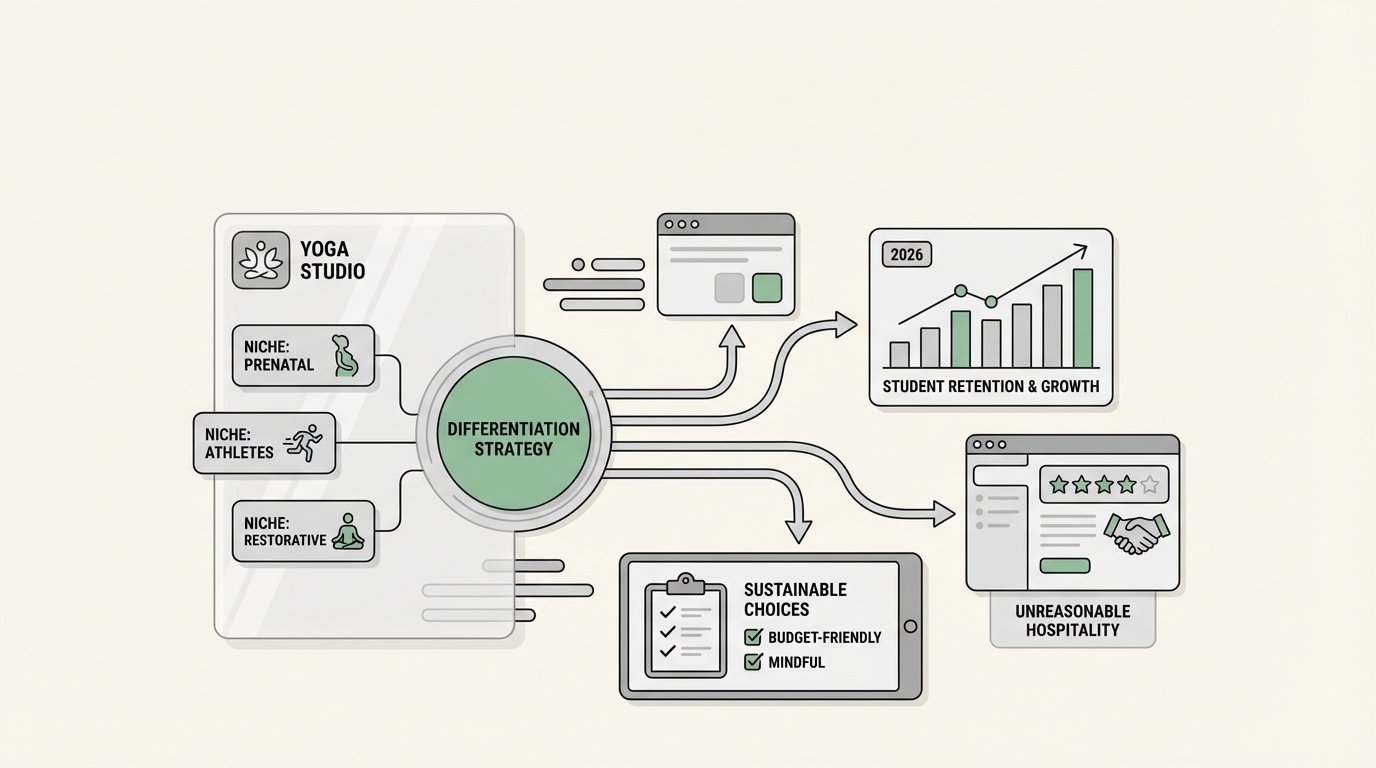
7 ways to actually differentiate your yoga studio in 2026
7 ways to actually differentiate your yoga studio in 2026
Walk into most yoga studios and you'll notice something strange. They all look the same. Same bamboo floors. Same Buddha statues. Same playlist of ambient flute music. Same promise of "finding your center."
Students notice too. After a while, every studio blends into one beige, incense-scented blur. And when everything looks identical, the only differentiator left is price. That's a race to the bottom nobody wins.
Here's the good news: standing out doesn't require a massive renovation, a celebrity instructor, or a marketing budget that rivals Lululemon's. The studios that build real loyalty in 2026 are doing it through small, intentional choices that cost more in thoughtfulness than in dollars.
Let's break down seven practical ways to differentiate your yoga studio this year. Each one is budget-friendly, sustainable for your sanity, and grounded in what actually keeps students coming back.
1. Niche down to stand out
The most successful studios in 2026 aren't trying to be everything to everyone. They're becoming the clear choice for someone specific.
Generalist studios struggle because they compete with every other studio in town. Niche studios compete with nobody. When you're the only prenatal yoga studio in your area, or the only one specializing in yoga for athletes, or the only trauma-informed practice, you own that space completely.
Let's look at some profitable niches that are working right now:
Prenatal and postpartum yoga - New parents are desperate for community and movement that understands their changing bodies
Restorative yoga for burnout recovery - Targeting high-performers who need nervous system regulation, not just a workout
Yoga for specific populations - Seniors, athletes, people with chronic pain, desk workers
Trauma-informed yoga - Creating safety for students who've had negative experiences in traditional fitness spaces
The key is choosing a niche that aligns with both community need and your genuine expertise. Don't pick "yoga for runners" if you personally hate running. Students can smell inauthenticity from the parking lot.
Cost to implement: $0. Just clarity and focus.
At Harmonic Odyssey, we see this principle in action through our work with high-performers navigating transition. The studios that thrive are the ones that get specific about who they serve and why.
2. Build an "unreasonable" hospitality experience
Most studios treat customer service as an afterthought. The front desk person is checking Instagram. The teacher barely makes eye contact. The space feels transactional.
The studios that build cult-like loyalty do something different. They create moments of unexpected care that students remember and talk about.
Here's what that looks like in practice:
Remembering names - Not just "see you next time" but "great to see you again, Sarah"
Following up after first classes - A simple text: "Hope you enjoyed class today. See you again soon?"
Creating rituals - One studio owner puts up a big chart where students write their names and add stickers every time they come to class. Meet a goal, get a prize. Low-tech, high-engagement.
Noticing when students disappear - Reaching out after two weeks of absence with genuine concern, not a sales pitch
These touches don't require expensive software or elaborate systems. They require attention and a genuine desire to make people feel seen.
As one long-term studio member shared on Quora: "The owner is flexible and super approachable, always soliciting feedback. Monthly fee with unlimited classes, automatic payment option; benefits with monthly membership such as 2 free guest passes monthly, free mat rental, discounts on workshops."
Cost to implement: Minimal. Mostly attention and simple systems.
3. Invest in teacher retention (your actual product)
Here's something studio owners don't want to hear: students don't stay for your brand. They stay for their teacher.
When a beloved instructor leaves, students follow. Sometimes to their new studio. Sometimes out of yoga entirely. Either way, you lose.
The studios that win in 2026 treat teacher retention as their highest priority. Not because they're nice (though that helps), but because it's the single biggest factor in student retention.
A yoga teacher with Yoga Alliance certification put it bluntly in a Quora discussion: "All jokes aside, the quality of the teachers makes or breaks a studio. Intelligent, knowledgeable, sensitive, and insightful teachers keep me coming back time and time again. Teachers whose classes are disorganized, or who have no knowledge of alignment, or who focus more on producing bikini bodies than enlightened minds send me running for the hills."
So how do you keep great teachers without breaking the bank?
Competitive compensation strategies beyond base pay:
Revenue sharing for workshops and special events
Continuing education stipends (even small ones signal investment)
Flexible scheduling that respects their other commitments
Clear pathways to senior teacher status with pay increases
Creating growth opportunities:
Mentorship programs pairing senior and junior teachers
Opportunities to develop specialty classes or workshops
Input on schedule planning and studio decisions
Professional development support
Building teacher community:
Regular teacher gatherings (not just meetings)
Celebrating wins together
Creating a culture where teachers support each other, not compete
The math is simple. Replacing a teacher costs far more than keeping one happy. Invest accordingly.
Cost to implement: Strategic. May increase payroll but reduces churn costs significantly.
4. Design for the nervous system
Clean studios with good lighting are table stakes in 2026. Every studio has that (or should). The differentiator is designing spaces that actually regulate the nervous system.
Here's the distinction: a clean studio is pleasant. A regulating studio makes students feel safe enough to drop into their bodies. That's when transformation happens. That's when they come back.
The research on what students value is clear. As one practitioner noted: "Cleanliness and open space. An experienced but more importantly a kind and gentle instructor. A peaceful environment consisting of a small but focused group of yogis. Simply aesthetic surroundings, with wooden floors, a green plant in the corner, and natural sunlight through the windows."
Elements of a regulating studio space:
Lighting that shifts throughout the day - Bright and energizing for morning classes, dim and warm for evening
Sound design, not just music - Acoustic treatments that reduce echo, white noise machines for privacy
Spatial design that feels safe - Clear sightlines, no hidden corners, enough space between mats that students don't feel crowded
Natural elements - Plants, natural materials, views of greenery when possible
Temperature control that works - Nothing destroys a meditative state faster than a freezing draft or stifling heat
One practitioner on Quora highlighted personal space as critical: "For me one of the biggest comfort factors in a studio is one that provides enough space so that the anticipated class size can put down their mats and do the practice without worrying about hitting or kicking anyone around them. Not having enough personal space takes my focus off the practice and makes me anxious."
The goal is creating a space where the body feels safe enough to relax. That's when students can actually access the benefits of yoga instead of just going through the motions.
If you're interested in understanding how nervous system regulation creates loyal students, Harmonic Odyssey's free 3-Minute Reset Method offers a practical introduction to these principles.
Cost to implement: $200-2,000 depending on current space. Start with lighting and plants.
5. Create frictionless technology experiences
The booking and payment experience is part of your brand. Students don't separate "the yoga" from "the app." It's all one experience.
A frustrating booking process creates negative associations before students even step on the mat. A seamless one makes them feel like you've got your act together.
What students expect in 2026:
Mobile-first booking - Most students will find you and book you from their phones
Transparent pricing - No hidden fees, no surprises, no "call for pricing"
Automatic reminders - Reducing no-shows while showing you care
Waitlist functionality - So popular classes don't feel like a lottery
Easy package management - Students should understand exactly what they have left
The "anti-chaos" principle applies here. Every point of friction in your technology is a reason for students to try the studio down the street. Remove friction relentlessly.
When to DIY vs. when to invest:
DIY works for: Very small studios with simple schedules, loyal student bases who don't mind calling to book
Invest in software when: You have multiple teachers, varying class types, membership options, or any growth ambitions
Popular studio management platforms include Walla, Mindbody, and Momence. Most offer tiered pricing starting around $50-200/month. The time you save on manual scheduling and payment tracking usually pays for itself.
Cost to implement: $50-200/month for quality software.
6. Build a hybrid community (not just hybrid classes)
Virtual classes are table stakes after the pandemic. Everyone offers them. The differentiator is building genuine community that exists both online and in-person.
Most studios treat virtual as an afterthought. The camera is propped in a corner. The teacher barely acknowledges online students. The experience feels second-class.
The studios winning in 2026 create hybrid experiences where virtual students feel as seen and connected as those in the room.
Beyond just classes, consider:
Community events that work virtually - Challenges with shared tracking, online forums for discussion, shared playlists
Teacher accessibility - Virtual office hours, Q&A sessions, Instagram Lives
Student-to-student connection - Pairing virtual students with accountability partners, creating small group experiences
Content libraries - On-demand classes that extend the relationship beyond live attendance
The retention power of belonging cannot be overstated. Students stay where they feel connected. Technology should enhance that connection, not replace it.
As the boutique fitness industry evolves, studios that can create community across physical and digital spaces will have a significant advantage. Learn more about building community frameworks that keep students engaged long-term.
Cost to implement: $0-100/month for platforms. Mostly requires intention and attention.
7. Expand into wellness services strategically
Yoga studios are becoming wellness hubs. The most successful ones in 2026 offer services that complement and reinforce their core yoga offering.
This isn't about becoming a spa. It's about addressing the full spectrum of what your students need to feel well.
Services that integrate naturally:
Yoga therapy - Working with specific physical or mental health conditions
Meditation and pranayama classes - Deeper practices for existing students
1:1 private sessions - Personalized attention for students who want to progress faster
Nutrition coaching - Supporting the physical practice with appropriate fuel
Sound healing - Complementary nervous system regulation
Massage and bodywork - Recovery and release
The key is strategic expansion. Don't add services just to add revenue streams. Add services that make your core yoga offering more effective.
How to test new services without overcommitting:
Start with workshops - One-off events to gauge interest before committing to regular programming
Partner before hiring - Revenue-share arrangements with massage therapists, nutritionists, or sound healers before bringing services in-house
Survey your existing students - What do they already pay for elsewhere that you could offer?
Track the data - Which services actually drive retention and revenue?
One studio owner shared on Quora that variety of workshops and the ability to sign up online were key factors in their 4+ year membership.
Explore Harmonic Odyssey's offerings to see how integrated wellness services can create a more comprehensive student experience.
Cost to implement: Variable. Can start with partnerships and revenue share arrangements.
Making differentiation sustainable
Here's the part most articles skip: differentiation only works if you can maintain it without burning out.
All seven strategies above are designed to be sustainable. But sustainability requires systems. Without systems, even good ideas become overwhelming.
The "without losing your mind" principles:
Automate what you can - Payment processing, reminder emails, waitlist management
Say no to good opportunities that dilute your focus - Not every workshop idea deserves to happen
Measure what matters - Retention rate matters more than new student count
Build a studio that runs without your constant presence - Documented systems, trained staff, clear protocols
The goal is creating a studio that thrives whether you're there or not. That's when you know you've built something real.
If you're ready to explore sustainable business practices that support both you and your students, Harmonic Odyssey's workshop offers frameworks for building a business that doesn't require your constant presence to succeed.
Start differentiating your yoga studio today
You don't need to implement all seven strategies at once. In fact, you shouldn't. Choose one. The one that resonates most with where your studio is right now.
Maybe it's getting clearer about your niche. Maybe it's finally fixing your booking experience. Maybe it's reaching out to your teachers and asking what would make them stay.
The studios that stand out in 2026 won't be the ones with the biggest budgets or the trendiest decor. They'll be the ones that made intentional choices about who they serve and how they serve them.
Differentiation isn't about being louder than everyone else. It's about being clearer about what you offer and why it matters.
Start with one step. Build from there. Your future students are waiting for a studio that feels like it was made for them.
Visit Harmonic Odyssey to explore resources designed for wellness entrepreneurs who want to build businesses that matter without sacrificing their wellbeing in the process.
Frequently Asked Questions
What is the most cost-effective way to differentiate your yoga studio in 2026?
Niche specialization costs nothing but clarity. Choosing a specific population to serve (prenatal, athletes, burnout recovery) immediately differentiates you from generalist studios and creates natural marketing angles.
How can I differentiate my yoga studio without expensive renovations?
Focus on hospitality and teacher quality. Small touches like remembering student names, following up after first classes, and investing in teacher retention cost little but create significant loyalty.
What technology do I actually need to differentiate my yoga studio in 2026?
At minimum, mobile-friendly booking with transparent pricing and automatic reminders. Most studios benefit from dedicated studio management software ($50-200/month) once they have multiple teachers or class types.
How do I differentiate my yoga studio when there are already several in my area?
Get specific about who you serve best. Don't compete on 'yoga for everyone.' Become the clear choice for someone specific. Students will drive past three generalist studios to reach the one that specializes in exactly what they need.
What role does community play in differentiating a yoga studio?
Community is often the primary retention driver. Students stay where they feel connected. Create rituals, challenges, and opportunities for students to know each other beyond just sharing a practice room.
Should I offer virtual classes to differentiate my yoga studio in 2026?
Virtual classes are now table stakes, not differentiators. The opportunity is in creating genuine community across physical and digital spaces, not just streaming classes. Focus on connection, not just content delivery.
How do I know if my differentiation strategy is working?
Track retention rate, not just new student acquisition. A differentiated studio keeps students longer. If your 90-day retention is improving and students are referring friends, your strategy is working.

